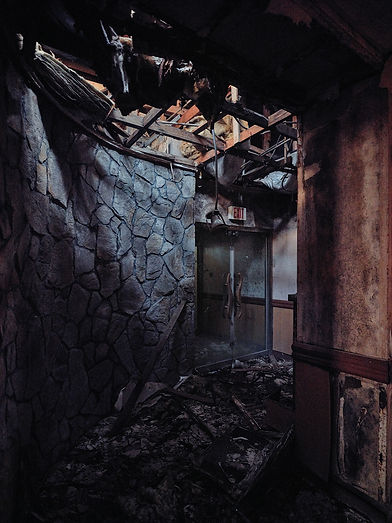
The Lost Land
2020-Ongoing
The Lost Land series is a story about a returned U.S. military base.
U.S. military bases in Korea have served as important strategic strongholds within the geopolitical and military environment of the Korean Peninsula. However, over the past few decades, the redeployment of U.S. Forces Korea and the return of bases have been taking place. U.S. military bases are not simply closed military facilities.
Originally a garrison established by the Japanese military during the Japanese colonial period to govern the Korean Peninsula, this site holds a significant place in the flow of modern and contemporary Korean history as it was transformed into a U.S. military base following the outbreak of the Korean War after liberation. The currently repatriated U.S. military base is, in itself, a complex space where the legacy of colonial culture and the changes in the East Asian security landscape are superimposed.
I document these spaces through the medium of photography, shed new light on their historical and social significance, and explore the potential for urban regeneration and cultural utilization. The U.S. military bases, built by the Japanese army, feature many low, elongated structures—Japanese architectural elements reflecting the country's earthquake-prone climate. Subsequently, as the U.S. military utilized the facilities for the longest period, the interiors transformed into a Western and exotic landscape. Having spanned at least 80 years, these spaces reveal traces of history and layers of time within their worn and dilapidated exteriors.
U.S. military bases are referred to by the prefix "CAMP," such as CAMP WALKER, CAMP LONG, and CAMP MACNAB. Due to their nature as military facilities, civilian access was strictly prohibited; however, as ownership was transferred from the U.S. military to the Ministry of National Defense and subsequently to local governments during the process of their return to Korea, they gradually began to reveal themselves to the outside world.
From 2020 for about a year, I requested filming permits from each local government to film U.S. military bases located in various regions, and from 2021 to 2024, one year after I started the work, I was able to film returned CAMPs in various parts of the country, including Wonju, Daegu, Chilgok, Uijeongbu, Bupyeong, and Jeju.
The Lost Land series is an exploration of a space on Korean territory where various historical actors intersect—a place built by Japan and used by the U.S. military for the longest period. I visualize this complex sense of place and the traces of ownership, use, memory, and forgetting that change according to historical currents, using photography as a medium possessing both documentary and compressible qualities. By capturing disappearing boundaries and lingering traces, I aim to pose the questions we must now confront while standing within them.